
"Do not judge others and you will not be judged. For as you judge others, so you yourselves will be judged . . ." (Matthew 7:1)
"Many of us have learned patterns of speaking that backfire. One of these is judging other people. Often, we do this to feel better about ourselves, and possibly to meet our own needs for acceptance and belonging, yet just the opposite happens. Whenever we judge anyone else in anyway, we create a barrier and distance between us and the other person. This occurs every time we judge another person as lazy, stupid, a bad dresser, egotistical, or uncaring. Every moralistic judgement separates us from other people and limits our ability to meet the very needs we set out to meet, such as feeling better about ourselves, acceptance and belonging.
"Instead of judging, then, notice how you feel about someone's actions, or how you feel when you see something. If you are skiing and someone cuts in front of you, rather than thinking [he or] she is a jerk or a maniac, consider that you are scared and you'd like the slopes to be safer. This slight shift from judging other people to awareness of how their behaviour affects you can make a profound difference in your ability to live peacefully."
From 'Peacful Living' by Mary Mackenzie
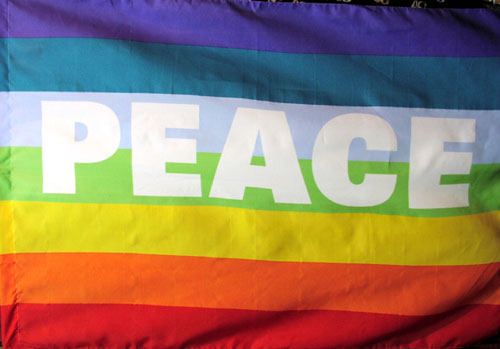 The above seems particularly relevant with Holocaust Memorial Day being marked on Thursday of this coming week.
How much distrust and enmity between races and religions stems from people judging others? We hear of people feeling afraid of young people when they gather in groups on street corners, yet sometimes these youngsters just want somewhere to meet and are merely chatting. There seem to be more tall young men around, so shorter people may well feel intimidated by them, but that doesn't mean they are violent.
It only takes a few steps from turning our feelings of fear into an assertion that a particular group are violent and then that all people like that are violent, whether young men, or young men from a particular racial group. From there a general distrust of all people from that ethnic background may lead to us seeing them all with suspicion, perhaps even deciding to strike them before they strike us.
Sometimes religion can encourage people to judge others, such as when people from one religion believe that God is displeased with everyone who does not accept the teachings of their religion. This might just make the adherents of this religion annoying as they try to point out to everyone 'the error of their ways', but it can cause one group of people to see another group of people as enemies of God whose lives have less value than their own. The attitude of the Crusaders towards the Muslims is an example of this, which has had dire repercussions for nearly a thousand years.
In Germany between the wars many people were keen to be judgemental and prejudiced where the Jews were concerned, partly due to religious teaching and partly due to resentment and jealousy towards wealthy Jews whose businesses continued to thrive while many Germans struggled to make ends meet during the Depression of the 1930's. This attitude meant that some people felt the Jews were better out of the way, so they didn't ask too many questions when their Jewish neighbours disappeared.
 Unfortunately the idea that life would be better without other people around, so much so that people are prepared to kill people from another ethnic group continues today, with the wars in Rwanda and what was once Yugoslavia, not to mention what is still happening in Israel-Palestine, as prime examples.
'When will they ever learn?' 'Wann wird man je verstehen?' as the song, 'Where Have all the Flowers Gone?' says.
Whether it is due to our own inclination or religious teaching it is always better to avoid the temptation to judge others if we want fulfilled, enriched lives and a peaceful world.


